
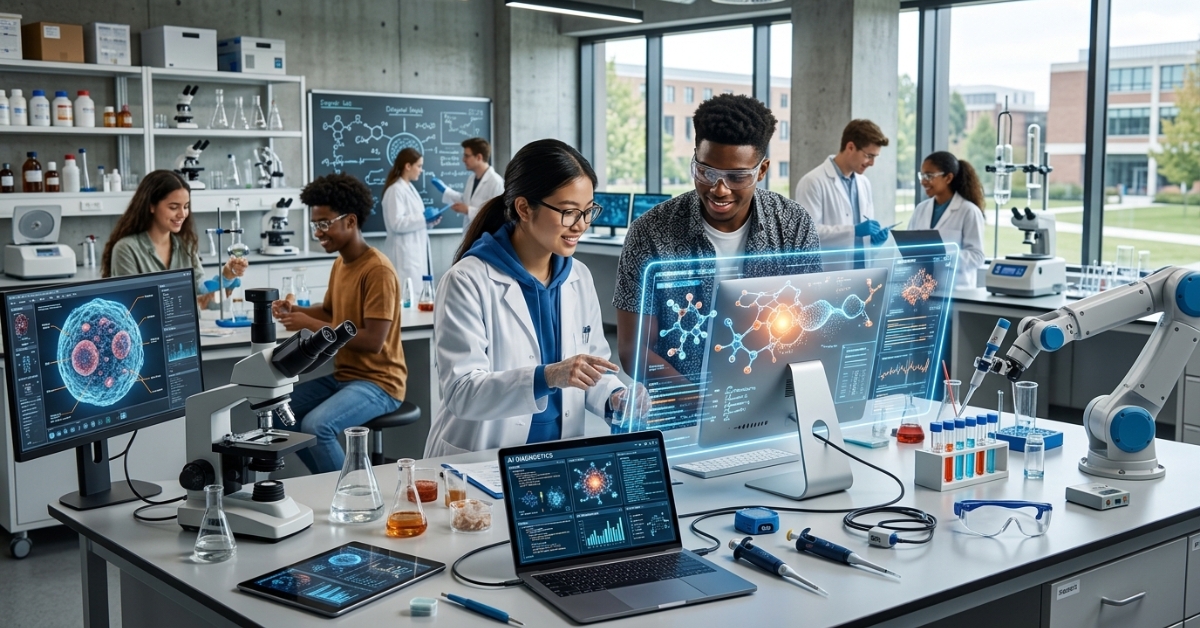
As technology continues to evolve, the integration of Artificial Intelligence (AI) into educational environments, particularly in the fields of Science, Technology, Engineering, and Mathematics (STEM), is revolutionizing how subjects are taught and learned. This blog post explores the various AI tools and technologies that are shaping modern laboratories and enhancing the learning experience for students.
Enhancing Learning Through AI Simulations
AI-driven simulations are becoming increasingly popular in STEM education, providing students with the opportunity to experiment in a risk-free environment. These simulations use sophisticated algorithms to mimic real-life scenarios and experiments that would otherwise be too costly or dangerous to conduct in a school setting. Tools like Labster and PhET provide interactive, virtual lab experiences that allow students to perform experiments and learn from their mistakes without any real-world consequences.
Personalized Learning with AI
One of the most significant advantages of AI in education is its ability to tailor learning experiences to individual students. AI systems can analyze a student's previous answers and learning speed, adjusting the curriculum to fit their unique needs. Platforms like Carnegie Learning and Smart Sparrow are designed to adapt to the learner’s progress and provide customized feedback, ensuring that students not only remain engaged but also receive support precisely where they need it.
Automated Grading and Feedback
In traditional learning environments, timely and detailed feedback can be challenging to provide due to the sheer volume of work requiring attention. AI technologies in STEM labs can automate the grading process, offering immediate feedback to students. This not only enhances learning by allowing students to quickly understand their mistakes but also frees up valuable time for educators to focus on more critical teaching tasks. Tools like Gradescope and Turnitin use AI to assist in these areas, improving the accuracy and efficiency of assessments.
Virtual and Augmented Reality (VR/AR) in Labs
VR and AR technologies are taking AI in STEM education to new heights by creating immersive learning environments. These tools enable students to explore complex scientific concepts in a visually engaging manner. For instance, zSpace offers a range of AR and VR experiences that allow students to dissect virtual animals or visualize molecular structures in 3D. This not only makes learning more interactive but also helps in retaining complex information more effectively.
Challenges and Future Directions
While AI presents numerous opportunities for enhancing STEM education, there are also challenges that need to be addressed, such as ensuring equitable access to technology and safeguarding student data privacy. Looking ahead, the focus will be on overcoming these hurdles and further refining AI tools to be more intuitive and effective in fostering a deeper understanding of STEM subjects.
In conclusion, AI is setting a new standard for how STEM education is delivered. With continuous advancements in technology, AI-driven tools in modern labs are not just enhancing the way students learn but are also preparing them for a future where digital literacy is paramount. The key to successful integration lies in balancing technological adoption with critical pedagogical strategies, ensuring that AI serves as a complement rather than a substitute for traditional educational methods.



Comments (0)